Monday, July 14, 2014

The Finale: Australia Week 5

Whenever I thought of the rainforest, my initial thought would always be the Amazon. That was before I went to Australia. Now I think of the Daintree Rainforest in the province of Queensland. The Daintree Rainforest is 180 million years old, making it the oldest rainforest in the world and tens of millions of years older than the Amazon. It spans 1200 square km from the Mossman Gorge and the Bloomfield River on the eastern coast north of Cairns.  I wish I could've captured even a fraction of one third of Australia's frog, reptile and marsupial species, 65% of its bat and butterfly species, 18% of its birds species, and countless endemic species living in the Daintree Rainforest.
As soon as I stepped out of the van that had driven us from the pier at Cairns to the Silky Oaks Lodge in Mossman, all around these species roamed sheltered by the bottle trees, cluster fig trees, the 300 million year old King Fern, and hundreds of other species representative of the botanical evolution throughout the world. My parents, Brianna and her mom, Heather, and I each had our own villa elevated 25 feet off the ground on stilts. They by no means dominated the surrounding ecosystem, but rather blended in with dangling leaves, vines, and ferns and served as pedestals for perching for the squawking parrots, king fishers, and brush turkeys. Even the pool was hidden within the organized knot of flora and fauna and disguised by artificial waterfalls and aquamarine water reminiscent of the Great Barrier Reef.

The first of our two days we went to the Mossman Gorge. The gorge actually runs adjacent to Silky Oaks and lodgers can swim or kayak in it, but the national park associated with the gorge is 15 minutes away. Our tour guide, a member of the aboriginal tribe indigenous to the Daintree nicknamed Skip, led us through the narrow trail blockaded by intricate spiderwebs stretching nearly 2 meters wide. He explained the significance of every piece of nature Daintree has offered his people, formally known as the Kuku Yalanji, for the thousands of years they have called this rainforest their home. For example, the buttress roots of many of the trees were used to make canoes whereas their bark can be used to build the structures of huts and the bark of the vines can be dried out to make string. They were carefully to never stay in one area too long, transitioning from the deep rainforest, to the coast, and to the grasslands so as to not decimate the land for further use.


Skip talked more and more about the abundant utility of the rainforest's resources, including using eucalyptus leaves for soap by rubbing them in water and the sediment from different rocks to paint peoples' bodies with their personal and families history. What I found most admirable about his tour, though, was that he only mentioned the persecution by Westerners once. He said that white people had kidnapped his grandfather and much of his extended family in order to forcible claim the rainforest for commercial uses. On the surface, his tone was merely informative, but underneath a indignant spite burned. Yet he, like many of the other aboriginals who white people have apathetically relocated, have worked to coalesce their culture with the commercial realities and necessities of the modern world. He exemplified an indigenous worker committed to his field, an indigenous worker that many white people, including the government and some of those that we talked to at Myella, do not confidently say exist.


The next day, we experienced the rainforest and the adjacent coast from the more Westernized point of view: the biological and ecological. With an extensive background in outdoor leadership and adventure sports like backcountry skiing, backpacking, mountain biking, and kayaking, our tour guide, Barney, instantly tapped into my academic and personal interests. In the Jindalba Boardwalk, he spoke about the ability of the young, two foot high tree to live without ample sunlight absorbed by the older, taller trees for long periods of time and then to sprout up rapidly as soon as one of the older trees fell. On Cape Tribulation, he pointed out the small crustaceans that burrow in the sand, leaving stacks of perfectly spherical sand balls and hieroglyphic-like patterns. And he clarified that the violet, speckled ovals lying all over the ground were not cassowary (very rare bird about the size of an emu with black feathers and a blue head) eggs but rather a cassowary plum. The two species are mutualistic: the cassowary eats the plum safely, which is laden with poison and toxic to all other animals, and then spreads the seeds all over the rainforest in Queensland. I couldn't believe the extent of his knowledge nor could I resist eating up every piece.

Despite the fact that, as my dad mockingly noted, our tour could have been advertised for members of the AARP since the other eight people were couples over the age of 70, the Forster-Magliozzi clan managed to thrive. Heather made friends with a kangaroo at the café we ate lunch at who, according to her, "stared deep into her eyes," I found an Australian to talk with about backcountry skiing, and my dad managed to last yet another day with four very, shall I say, open females.

Early the next morning, we drove back to Cairns to the airport to fly to Uluru-Kata Tjuta National Park, a desert national park and World Heritage Site in the center of the country. We stayed in tents at Longitude 131. When I say 'tents,' though, don't picture in your head a rain fly, poles and stakes; instead, picture a sleakly modern, metal cabin raised about 15 feets off the ground with a canvas tarp stretched in a curved pyramid across the top. And if you can't picture that, you'll at least be able to begin to understand when I tell you that Prince William and Princess Kate stayed at Longitude 131 in late May. Yeah. You get it now.

But that was just the tents. Then there's the food. Yes, breakfast, lunch and dinner are all 5-star quality. But little can compare to the grill marks charred on two perfectly portioned pieces of chicken breast seasoned lightly with salt and pepper and served over rainbow quinoa soaking in the chicken juices. I couldn't stop my fork from returning over and over to the bright wasabi caviar bursting with the refreshingly pungent spice as I bit into the sesame crusted mahi mahi. Even their homemade muesli, the European/Australian version of granola that is served cold, with milk like cereal, swept away the nighttime desert chill lining my torso with warm spices like cinnamon and all-spice.


I needed that warmth every morning since we would leave for tours of the two rock formations, Uluru and Kata Tjuta, before sunrise when all the heat that had escaped the air and the sand had yet to be replenished by the sun. The land in the national park, as of the late 20th century, is owned by the local aboriginal tribe, the Anangu. Despite this, most all the licensed tour guides there are not Anangu but rather white. At first as we walked the 10 km perimeter of Uluru, and through the 32 rock heads of Kata Tjuta, I was greatly turned off by the supposed ignorance of the guides in terms of their knowledge of the sacred cites of which the visitors could not take pictures and ceremonies of the Anangu. They would shrug their shoulders and say, "We can't tell you about them because we don't know." I wanted to know everything of this massively flat landscape interrupted and dominated by two burnt orange rock formations radiating mystery. Even the most indifferent tourist couldn't avoid the raging curiosity sparked by the holes on Uluru that create an image of a human brain used by the Anangu as a male sacred site.

I finally began to understand during our last tour of the trip that focused solely on the cultural history of Uluru and the Anangu, I finally understood. Our tour guide told us all that she could, again which isn't all that much, and that she had no other information because the Anangu wouldn't tell her. At first I thought, 'Great, another tour of incomplete information.' But then she said, "I can't tell you because the Anangu have a hierarchy of information they allow certain individuals in and out the the tribe to know." Within the tribe, the elders know everything and only tell others if they seek out the elders' guidance, and if the elders' believe they are mature enough in terms of both age and character to handle such information. Even so, women know nothing of the men's sacred information and vice versa. Outsiders, thus, are eligible for even less information not so much out of spite for the intrusion by Western and white society but more so because the vastly different means by which we live that are dictated primarily by commercialism do not coincide with the priorities in the lives of the Anangu.


In a way, I compare it somewhat to the education system. Although people do not openly deny aboriginals or many urban minorities in the United States the right to quality and higher education, their eligibility for such an education is for some reason inferior to that of whites. Obviously the Anangu's reasons for not sharing their cultural information with others is rooted stronger in cultural history than my example, but in comparing the two, I can begin to understand the division between groups of people at the most basic level.

As much as I loved waking up to such a striking environment much different from the view of Pike's Peak I wake up to every morning at school, I was satisfied to leave on our last day. I felt as though I had a much of a grasp as I could on the Anangu and the reason why Uluru-Kata Tjuta was named a World Heritage Site and had hiked every trail in the park (typical Forster family mentality, right?). Besides, I was a bit tired of waking up at 6:15 AM when it was 30 degrees outside while sleeping in a 'tent' without heat and a floor so cold I'd have to wear slippers. Underlying that satisfaction, though, was a remorseful acceptance that my trip had basically ended. All that was left was our second stop in Sydney for higher quality food in Chinatown and at Pie Face, and finally the plane ride home.

I wouldn't say this trip surpassed some of my others in terms of extreme adventure or exposure to exotic culture especially when I compare it to backpacking in Alaska for a month or learning first hand about non-violent political protest in Serbia. I'll never forget this trip, though, because it was the first time that I traveled without adults or a paid organization and planned four weeks of constant travel with someone about my age. Rather than having every hour or every day planned as with most of my previous vacations, I embraced the spontaneity and budgetary restrictions of traveling as a college-age student (even though I hated looking at my drained checking account when I got back to the United States). We could explore cities without the rehearsed, sometimes narrow perspective of a tour guide, sleep on the beach without a to-do list lingering in our dreams, and giggle sinisterly when we tell our parents we went sky diving and bungee jumping.

Of course I would've loved to stay in Australia for the rest of the summer riding the Greyhound Bus and sleeping in bunk beds at youth hostels throughout the rest of the continent, but that's not what I miss the most I think. Maybe it's Brianna and my furry, kangaroo friend Bendy, but what I think I really miss most is waking up next to this crazy loser every day. Cheers, my friends.

Tuesday, July 1, 2014

Australia Week 4

Brianna and I had two days left of freedom in Australia after leaving the Myella Farmstay, and we were intent on exploiting every last second of “do whatever you want” time before meeting our parents at 12:45 PM sharp on June 21st. After that, we would no longer accept various colored sheets from the receptionists at youth hostels to stretch over the shabby mattresses on our bunk beds, eat $10 meals in Chinatown, and throw our packs into the storage area of the Greyhound Australia buses. Instead, we would be cruelly confined to plush pillows in private rooms, five star quality, four course meals, and porters to transport our packs. Such a shame, right?

In all honesty, it was hard to let go of the lifestyle Brianna and I had grown so accustomed to the past four weeks. It was the first time I had felt homeless. There was a increasing satisfaction in that homelessness, that day after day I had yet another city, beachfront, farm or teepee to crawl through and feel their respective cracks in concrete, jagged shell remains, brittle grasses and coarse strands of dreadlocks on the pads of my fingers and toes. Every step, harmonized by a creak in my weary back, was another diversion from the routine of my life in the United States. I was intoxicated by that melody, and not sure if I was ready to fast forward to the next beat.

I figured if I had to (and there was no changing my parents plans), Brianna and I would leave on the highest note possible. To do so, we figured we had to actually plan for at least one of these two momentous days unlike acting spontaneously the morning of. With our track record, though, it was to be expected that our activity itinerary for one of these two days would be as last minute as possible. Our original plan before Cairns was to stay in Mission Beach for two nights. We lasted all of 24 hours, plagued by a cloudy drizzle and stunned by a 'town' consisting of a strip of four restaurants and six stores. Out of immovable boredom, we rescheduled our bus for a day earlier, leaving us with an extra day in Cairns before jumping out of a plane. So when the receptionist at the Cairns youth hostel asked if we needed help booking any activities in Cairns, what else would you expect us to answer but bungee jumping?

My dad had bungee jumped in the past, and when I was younger, I thought he was crazy. That was before I indulged in, rather than quelled, the sweet nectar of adrenaline. Now, I was equally crazy. I dared to climb 196 to the top of a 162 foot tall platform at AJ Hackett's Cairns Bungee Jump Center. As the employee on belay wrapped towels around my ankles and clipped the carabiner onto my harness, I stoked the fire burning in my blood to elevate the scale of the upcoming explosion. And when a bolt of fear electrocuted my brain as I looked below from the edge of the platform, I absorbed the shock with a deep inhale and, well, jumped. I expected to scream in excitement, but instead, I was completely calm. My body was so weightless that I couldn't feel the adrenaline pumping inside me but rather revolving around me in a color-shifting aura. I stretched my hands towards the top of the miniscule pond below that grew in size drastically disproportional to the two or three seconds I was actually free-falling. It expanded more like viscous molasses rather than thin cake batter. I could have free-fallen forever, never retracting the smile stretching across my face for miles and exposing every one of my teeth.

When the tips of my fingers finally did graze the surface and my body bounded back upwards like a rag dog, my squinty-eyed smile burst into a light-headed giggle. Even as the length of my rebound decreased and I reached for the raft paddle held upwards by the employee on the pond, I kept laughing with hopes that somehow its vibrations would lift me back to the top of the platform so I could jump again. Sadly, I was detached from the bungee cord too fast for my far-fetched fantasies to even begin to come to life. Instead, I relived my jump over and over in the five pictures I had paid $50 extra to receive and imagined jumping off the 200 METER (about 600 foot) tall platform AJ Hackett's company was building in China. Some day, I kept thinking. For now, though, we had yet another adrenaline-junky activity for which we had to prepare ourselves.

Day two, our final parent-free day, was actually planned three weeks prior when we were staying in Byron Bay. I had wanted to dive in Colorado for my eighteenth birthday, but with the start of my freshman year, free time was not really an expendable resource. Looking back, I'd say it was for the better. Now, I would sky dive over the Great Barrier Reef the day after arriving in Cairns three hours before meeting my parents at the pier.
The night before our jump, Brianna and I meticulously pried through our heaps of clothes we had poured out of our packs and onto the floor, ensuring our diving outfits were as perfect as a wedding dress. So, when my alarm screamed at 6:15 AM, I pulled on my signature shirt that I wear in at least half of the pictures I am tagged in on Facebook: my obnoxiously neon yellow, synthetic shirt with “SoccerPlus Goalkeeper School” written in bold black letters. Anyone in Friday morning traffic would look up at the sky and see me: the little, yellow dot hurdling towards the ground.

Unlike with bungee jumping, during which the threat of the ground is only a few feet away, during sky diving, you have almost 34,000 feet between you and the ground while free-falling. The reality of the consequences of part of the equipment faltering is so far away physically, that my mind could only comprehend the experience with blurred, unrecognizable lines like bleeding watercolor painting. While free-falling, I thought more about the beauty of the swelling ocean and the lush, dark green masses of rainforest below than the fact that I had just jumped out of a plane with a stranger on my back. After the parachute deployed, I calmly transitioned to my task, steering the chute and spinning wildly in circles, rather than regaining feeling in (what I assume was) my pounding chest. It wasn't until I slid smoothly across the grass on my butt upon landing that I had even the slightest sense of what I had just done. Even a now, a week later, after looking through my pictures time after time, I still can't really wrap my mind around it.
 
We headed back to our hotel, dazed partially from the drastic altitude gradient we had just experienced and partially from lack of sleep, and grabbed our packs, backpacks and two overstuffed bags of yogurts, cheeses, eggs, bacon, and Tim Tams. After two 30-day backpacking expeditions and countless multi-day ones, I'm obviously used to a heavy load. But this, this was unbearable especially for a 25 minute walk from one side of downtown Cairns to the other. Every two minutes or so, either Brianna or I would have to stop and rearrange the positioning of our hands to regain some sort of circulation. Ten minutes into our trek only seconds before both of us would have collapsed, some heavenly angel cast its blessing and granted us with the greatest gift even a higher being could ever give: a shopping cart. There it was, resting on the edge of the sidewalk just to the left us, waiting to be claimed. There was no hesitation, no self-conscious fear of judgment. That cart was ours.

We plopped our backpacks and grocery bags inside the cart and strided forward towards the pier with overwhelming relief and a new-found vitality. There's no denying it: we looked like hobos. We were the happiest hobos, though, with the most swag of anyone glaring inquisitively at us. As we sat on the pier leaning against the back of the shopping cart, our parents, who had just landed in Cairns, walked towards us asking each other who the hell those two girls at the end of the pier could possibly be. "Maybe that's Brianna and Elizabeth." "No, it can't be." "Wait, it definitely is. That's Elizabeth's neon yellow goalkeeper shirt!" Brianna and I galloped like crazy monkeys towards them, and embraced them for the first time in almost a month. The Forster-Maglozzi clan reunited at last.
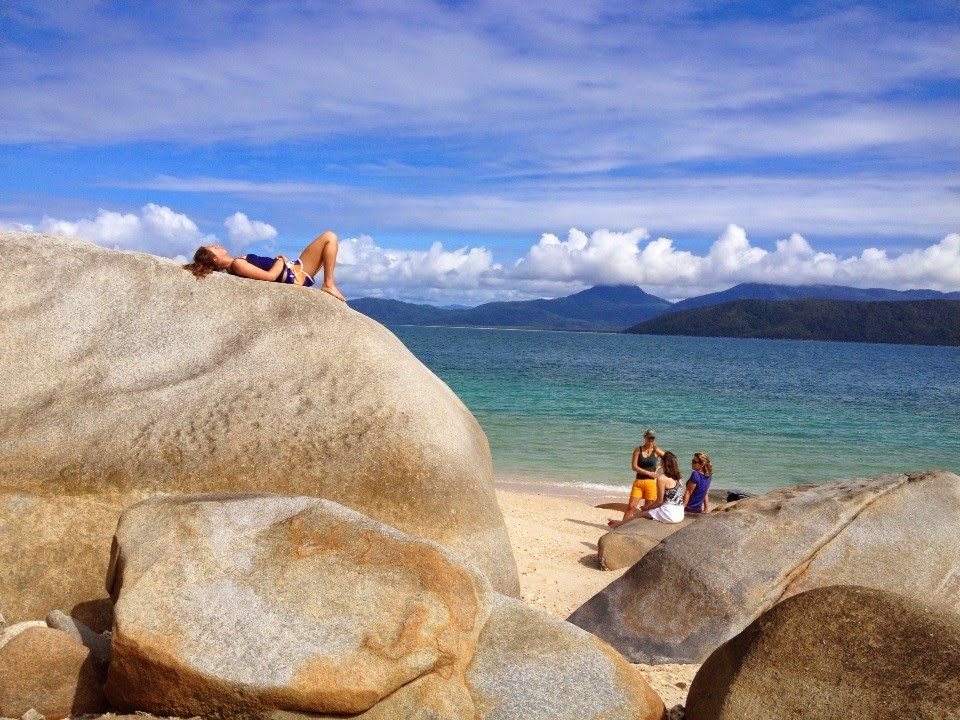
We climbed on the ferry to Fitzroy Island, an island composed almost entirely of a national park about an hour off the coast of Cairns. Until arriving in Cairns, nobody Brianna nor I had talked to had ever heard of Fitzroy which could have been either a cause for concern or a greatly appreciated relief from the populated cities. Thankfully, the coral-lined shores and undulating inland hills of the island proved to be the perfect secret hideway for the first leg our of family journey. We started first with the hills, hiking up painfully steep but short sections of crumbling stone alternating with short downhills. The island has in fact the highest summit elevation of any of the surrounding islands reaching a monstrous 882.5 feet. Watch out Colorado 14ers, you've got some competition. 

The trail ended at the island's lighthouse, from which we could see the various shades of blue blending into one another as the depth of the ocean increased and decreased. The next day, we would snorkel throughout similar areas forty-five minutes away from the island. I would get to see the pearl white coral brutally massaging the bottoms of my feet on the beach bloom into vibrant shades of peach, plum, kelp-green, and sunset pink from the polyps living inside. I would float silently over schools of metallic fish flickering their tails, propelling them towards the algae and kelp. And I would be nearly paralyzed by the sight of the dull-grey reef shark flashing its needle-point teeth. I saw this and so much more, yet I had still only seen a miniscule fraction of the largest coral reef in the world, spanning 344,000 square kilometers of the waters off the coast of Australia.

Could you imagine if that entire area, or even a portion, bursting with an infinite color wheel of environmentally productive organisms and ecosystems essential to the health of our planet was gone? Although not on such a large scale, such degradation is ongoing due to an increase in sea surface temperatures and consequently, an imbalance in the calcium carbonate levels. The majority of the damage to the Great Barrier Reef since the end of the 20th century was caused by tropical cyclones, whose power is proportional with sea surface temperatures. The coral polyps that give the coral its color and its nutrients also die with the acidification of sea water caused by this chemical imbalance and oxygen starvation primarily. When the coral dies, the organisms that use the coral as a shelter or a source of food die, thus leaving their respective predators without prey on which to feed. I would never wish for the Great Barrier Reef to disappear, but if for the most unfortunate reason it ever did, I'm eternal grateful that I was able to experience its vibrantly, bio-diverse wonder now before it may be too late.
Fitzroy Island is also home to a turtle sanctuary and rehabilitation center run by the Cairns Turtle Rehabilitation Centre, a non-profit organization formed in 2000 by Paul Barnes and Jennie Gilbert. The turtles residing in the Fitzroy Island location are in the second stage of rehabilitation after spending an average of eighteen months in intensive care at a veterinarian facility. Many suffer from floater's syndrome which occurs when a turtle ingests a substance that they cannot digest. Unlike in the human body, which would manage to break down the substance despite its consequences, the substance would cause the turtle's other essential bodily systems to falter or even fail. Their muscles begin to break down and weaken substantially, causing them to float. They no longer can dive to find food, avoid predators and weather patterns, and continue maturing. If not rescued, floater's syndrome can lead to death.

The Fitzroy Island Resort, the only place of accommodation on the island, pays for the rehabilitation centre's lease and offers to its guests a tour of the turtle sanctuary (during which I learned all the information above). On the tour, you also get to meet two of the turtles, Barney and Bettie, who have had some of the most miraculous recoveries of any of the turtles currently at the sanctuary. In learning about their stories and those of the other turtles, the effects of pollution and the rising sea temperatures on the severity of storms (most recently Cyclone Yasi in 2011) in particular are evident on a peaceful, graceful species. And with the recent world-wide call for immediate action to curb the rate of climate change after the release of some dismal climate change reports, including one from the International Panel on Climate Change, the medical disorders plaguing these turtles are all too relevant to the drastic consequences climate change scientists are predicting if we don't change our engrained habits.

So, I left Fitzroy Island with an appreciation for two staple components of Australia's and the world's ecosystems that are currently at risk for eventual extinction, both of which suffer greatly from the increase in sea surface temperature and associated climate changes. With my equally environmental-hippie-dippie book, "Rewilding the World: Dispatches from the Conservation Revolution" by Caroline Fraser, in my hand, I was ready to venture into another ecosystem with ample endemic species and essential resources: the rainforest.

Wednesday, June 25, 2014

Australia Week 3

I'm going to do something a bit out of character with this post: write in reverse chronological order. Well, not entirely, but just a bit so I can share with you the more memorable, less disheartening experience first rather than depress or bore you with my complaints about Noosa to start. If anything, I'm just following journalists' inverted pyramid organization that puts the most important information at the beginning of the article. Might as well write in accordance with the guidelines of my future career, right?
When Brianna and I were planning our route, I let her for the most part grab hold of the reigns since this trip is primarily her post-graduation escape before entering the real world (I thankfully still have three more in the la-la-land of college). So, when we skypyed to choose which hostels to stay at, and she said she wanted to plan the entire itinerary around a farm stay at a cattle ranch called Myella in Barelaba, Queensland, I shrugged and happily agreed. Animals are fun and I could never turn down fresh beef.

Myella proved to be much more than just a rural area used to raise animals for sale and slaughter. Yes, the have 300 cattle grazing their 1,068 hectare ranch, and, yes, all the sausage, steaks and beef patties I ate were once the wide-eyed, curious cattle whose grey tongues would curl around the stalks of grass I held out. But, just as Lyn Eather intended when they converted part of her family's business into a farmstay in 1993, Myella shows its visitors truly the way of life of a small-scale, Australian cattle farm. For the first four of five days of our stay, Brianna and I were the only lodgers there solely for the farmstay, so Lyn and another employee, Shane, divided most of the labor between the two of us. We were responsible for collecting the horses in their stalls from their grazing area to feed them a mixture of buckwheat and medicated meal, milk the cows, collect chicken eggs, and feed the rehabilitated cockatoo. 

Brianna and my most important responsibility, though, concerned a baby kangaroo named Bendy. Bendy was found by a family on the side of the road after a car had killed his mother. The car also ran over, broke and bent his foot, hence the name Bendy. He is about two feet tall with grey fur with brown highlights and dark brown eyes barely discernible from his seemingly dilated pupils. He spends his time gently hopping around the farmyard next to the chicken coop and the dairy cow paddock nibbling on grass, laying pressed hard into the rectangular, metal gate around the fire pit, or standing fully erect sucking on his fingers like a baby with its thumb constantly twisting his ears forward and back to catch every sound passing through. Within a day of staying there, we practically adopted him, feeding him kanagroo milk formula three times a day from a bottle. He'd follow us around everywhere, whether we were lying on the grass reading or walking through the cattle paddocks. He even let us scoop him up under his tail and craddle him on his back. No matter if we scratched his back or his stomach, carried him or let him bound by our side, he always resorted to his perfect, upright posture with his fingers in his mouth. If it weren't for customs, Brianna and I no doubt would've taken him home to raise half the year in upstate New York with her and half in Colorado with me. Who knows, maybe he'd be the first kangaroo to learn to ski!

During the day when we weren't tending to our animals, we spent most of our time riding horses and dirt bikes. I've only ridden a horse about five times, and the last time I did was when I was probably eight years old in Colorado. When my family and I were waiting for the ranch owners to give us our horses, I whispered to my mom, “I hope I don't get that horse.” That horse was cement colored with dark brown spots splattered around its shoulders, and only had one eye. Of course, which horse do I get? The one without both of its eyes. Every rocky slope we went down, my horse's hooves would slip uncontrollably and jerk me to the edge of the saddle. Eventually, I started crying and continued until we finished our loop around the farm. Although I never had qualms about riding a horse afterwards, my last experience to say the least was not ideal.

Good news, I didn't end up in tears this time. In fact, if anything, my experience on my speckled shell white horse, Atlantic, bolstered greatly the respect I have for ranchers herding their cattle by horse. When I watched Shane on his horse, he conveyed assertively and smoothly to his horse where exactly he wanted to be, how slow he wanted to walk or how fast to trot, and whether or not it was the proper time to stop for grass, all while recounting Australian military history, farming practices and personal tales without a single hesitant glance at his reigns. Meanwhile, Brianna and my passivity from lack of experience forced us to accept inferiority to our horses. They'd ignore our steering commands and led us into a dense patch of leaves, launch into a trot as if racing with each other, and pull harder down on the reigns if we tried to deny their snack time. Part of me feels a bit ashamed for not trying harder to gain respect form this horse, but even just from the off-beat rhythm by which I bounced on and off Atlantic when he trotted, the horse could read lucidly my inexperience. Regardless of my competency, just watching the relationship grounded in mutual respect of a serious rider and a competent horse is an inspiring example of mutualism between humans and an intelligent, strong animal that has been the basis for most of the early advances in our civilization.
My dirt bike, I think, liked me a bit more than the horse even though I dropped it while walking it down a hill before even learning how to ride it. As the rain steadily pitter-pattered on the tin roof of the garage (for the first time there since April, might I add), Shane taught us the basic functions and controls of the motor bikes. The bikes were manual, which wasn't an issue for me since I drive manual at home, but added yet another layer of confusion for Brianna. We didn't need to use the clutch to shift to any gear except for first from neutral, which of course is the most sensitive switch. I can't count how many times Brianna stalled during that shift. I don't blame her, since when I learned stick shift at home, my dad and I spent an hour in the middle school parking lot shifting from neutral to first, afterwhich I swore I would never drive stick again. I had my occasional stall too, but only when I came to a full stop and didn't down shift all the way.

At dinner the night we first rode, the contractors who stayed at the farm (who all saw me drop the bike) asked with a snicker how our lesson was, expecting us to recount tales of falling face first into the mud on the slick, dirt driveway on which we spent the afternoon doing laps. Granted the shins of our jeans were died completely orange from the clay-colored gravel, so they did have reason to believe our afternoon was spent deflecting scolds of disappointment from Shane. Instead, though, we simply smiled and replied, “Neither of us fell.” 

The contractors all shook their heads and blink hard in disbelief that these two, relatively small American girls, one of which dropped the bike within two minutes of touching it, had mastered the bikes. The next night, when they asked us what we had done that day, we told them, again, with pride that we had graduated from laps on the driveway in 3rd and 4th gear to the 7 km dirt bike track that ran through the cattle paddock in 5th (the highest) gear. I wish they could've witnessed us standing up tall with our shoulders parallel to the handlebars as the bike cruised at 40 km/hr over the dried mud holes and convexities of the track. We even surprised the cows on the track, who would skittishly gallop away from these mysterious figures whose identity was indiscernible because of bulky, yellow race helmets. 

Despite their low expectations of our dirt biking abilities, Brianna and I made friends the contractors, three in particular, who Lyn would cook breakfast for at five in the morning and would return at night for dinner. They'd tease us about not nursing Bendy properly, remind us of the proper Australian slang words used to replace normal English words (ie. Thongs not flip-flops, State of Union not rugby), and chastise us for 'taking all of the food' even though their plates looked more like volcanoes. Brianna and I matched their sarcasm and threw all their jokes right back at them. I guess they appreciated it since on the last night, two of them taught (well, tried to) us to crack a whip (I ended the night with a couple quiet cracks and a red ear). 

In addition to the contractors, a group of local aboriginals were part of a workshop-documentary about becoming teaching aids in aboriginal towns. For Brianna and I, these conversations allowed us to see the white-aboriginal relationship and compare it to the white-Native American relationship in the United States. I found that the Australian government, on paper, tries to support and advance the aboriginals but has lost a bit of hope in their ability to change (not to say the should or should not, I'm merely recording inferences). For the aboriginals and the Australians working with them, we were able to debunk countless American stereotypes, like the famous notion that everyone in New Jersey is like Snooki and J-Wow and that all arrests are like those in Cops. 

All these experiences wouldn't have been possible without the hospitality and warmth of both Shane and Lyn. Shane not once faltered in patience with us, no matter how obvious of a question I asked or how large of a dent Brianna made in the motor bike when she crashed into a barb wire fence. No matter what, he had a story to tell from his service in the military, from the ignorance of a guest (one girl arrived to her motor bike lesson in a bikini), or from his interactions with the farm animals. If it weren't for the lure of adrenaline from the motor bikes Sunday and Monday when Shane had his days off, we probably would've wandered into the bull's paddock and broken a couple of ribs.

 Of course I have to thank Lyn as well, who cooked us incredible meals night after night, from homemade sausages with a sweet and regular potato bake to bacon meatloaf with string bean casserole. She even tolerated 10 km of running and listening to me blabber about whatever entered my stream of consciousness. I guess I shouldn't say tolerated since by the end, she could call her brother-in-law bragging about her accomplishment and I could walk away with an invaluable life-lesson to add to my collection from yet another corner of the world. Plus, she may have gotten us on the Youth Hostel of Australia website with a photoshoot with Brianna, Bendy, the orange YHA sign and I. Because of them and the rest of the Eather family, Brianna and I experienced five-star quality hospitality, gained a new furry family member, became double the bad-asses by learning to dirt bike, and may become famous among backpackers, when all we asked for was a bed to sleep in and a cow to milk. Oh, and they stretched this signature smile wide across my face. Thank you Myella. 

Just to confuse you (maybe even more), back track nine days to June 7th. Please? For me? K thanks.

With our minds mellowed by the peace and love reverberating throughout Nimbin, Brianna and I were ready to drift into a long sleep for our 14 hour bus ride to Noosa. Even hippie vibes as strong as those straight from the spirits hiding in the Nimbin museum couldn't repel the momentous frustration thrust upon us by multiple sections of the Australian transit system the next 12 hours. We took the hour and a half bus ride from Nimbin to Byron Bay, then the four hour ride to Brisbane. We knew we had a layover in Brisbane, so we hopped off the bus at 7:25 PM, and gathered our bags. I noticed that the Greyhound Australia ticket desk was closed, so I asked our driver how we knew which gate the bus to Noosa would depart from. “Oh, well that bus doesn't leave until 7:30 AM tomorrow morning. There are some hostels about 500 meters up the hill from here that you can stay at,” the driver said. We didn't move, and I dropped my backpack and cooler of food without even thinking.

There was no way we were wasting twelve hours at a hostel we had already stayed at just to wake up early the next morning to drive three hours to Noosa, especially since the 500 m hill was more like a Colorado 14er with our packs on. I would have slept in the transit station before wasting my money and energy on that hostel. We needed an alternative: the train. So, we went up to the train ticket desk and told the employee we needed to get to Noosa. He handed us tickets to Nambor, and told us we would have to take a cab from there to Noosa which inevitably would be expensive. Fine. Don't care. Just get me to Noosa. As soon as we got on the train, though, the conductor told us we had to get off two stops later because there was track construction. Seriously? We hadn't even gotten to Nambor and were already diverted to yet another bus. And, of course, when we finally arrive in Nambor at 10:30 PM, there isn't a taxi in sight and the bus driver is snickering at us in the corner for our 'ignorance.' I wanted to throw my pack at him and yell, “I'm a stupid American, okay I know!” I restrained myself, though, knowing he was our ticket of information out of here. He gave us the number for a taxi that cost over $100, but at least we made it to our hostel.

Not so fast. Our hostel room was canceled since we had expected to arrive the next morning. I was ready to flop on the couch in their TV room or set up my hammock in a train next to their parking lot at this point. For the first time on this trip, nothing had gone as planned. Thankfully, even after overbooking this particular night, someone had given up their room last minute, so we, for the next two nights in Noosa, slept in a private, double room 100 m from the beach. The next morning when my parents answered my Facetime, I told them what had happened, and my mom's response was, “Well, you look pretty awful.” Thanks Mom. I never would've guessed I'd have bags under my squinty eyes after 8 hours of torturous travel.

To say the least, Noosa didn't start well, nor did it continue well. It rained the next day at the beach, and we hid in our room with Breaking Bad and ravioli from the Byron Bay farmer's market that night. Oh, and the next day, when we were kayaking through the Noosa Everglades, it not only poured the entire day, but the wind was also howling and the waves were unbearable choppy. We managed to kayak for four hours, three of which were spent charging against the wind, current and rain to retreat to the parking lot two hours before we expected to be picked up. Although we laughed away the rain drops pelting us in the face with a lengthy photo shoot, Noosa was still not our friend. 

Our next stop was Hervey Bay, which we realized was mostly used as a gateway to the famous Great Barrier Reef site, Fraiser Island, not a destination itself. We managed to make it a destination, though, after meandering cluelessly around the marina before finding a...er...beach. This beach had neither waves nor people. Seriously. I don't know whether it was because it was winter or weekdays, but we were alone on the beach all three days. It was truly wonderful, though. I could read my mountaineering book, Epic, without having to reread a sentence four times over because I instinctively started to eavesdrop on a conversation between a couple or a fight between a mother and her child. I could fall asleep without fear of my Australian lover that Brianna and I have been searching for seeing me drool onto my towel. And I could take selfies with pelicans as I wanted without a surf boarder scaring them away as the rode a wave onto the shore. Especially with our cruiser bikes we rented to bike to the beach every day, we returned to our zen contentness with the simplicity of a calm life we had captured in Nimbin. 
I learned a couple things this week. First of all that I will never, no matter how many people tell me how wonderful the beaches are and even though I saw a wild koala, return to Noosa. Noosa is cursed, and that's that. I also learned that non-tourist towns can either be a relaxing treat or a frightening burden. Hervey Bay and Rockhampton, I'm talking about you here. And lastly, I have added Myella to my forever growing list of places home to strikingly amiable people that have welcomed me into their world so different from my own. I'm just surprised I made it back to the Greyhound Station in Rockhampton after staying at Myella with Brianna at my side and without our kangaroo friend, Bendy, tucked away in one of our packs. 

For more information on Myella, check out their website at http://myella.weebly.com/

Thursday, June 12, 2014

Australia Week 2


We arrived in Byron Bay late the night of June 2nd, slept off our Greyhound Bus grogginess and headed for the beach early the next morning. As we walked towards the Main Beach with towels, sunscreen and books stuffedin our hemp bag, I immediately was able to gauge the type of people living in and the culture of Byron Bay. It is the quintessential surfer town. The streets are lined with shops selling Quiksilver, Billabong, and the like; Cars with as many surf boards as possible stacked on the racks occupy every parking space; and, of course, few people bother to wear shoes so as to not fill them with sand. I can definitely fit in here, I thought, except one thing must change: I need to learn to surf.
 
This sense of urgency exponentially increased as Brianna and I laid on the beach watching locals and out-of-towners surf on the eastern side f the Main Beach. By no means were any of these surfers of professional quality, nor would the size of the waves permit any sort of exhibition of professional talents. There was something so gracious about their calm intensity, though, that drew my mind beyond simply wanting to live the Jack Johnson-esque surfer life. My appreciation could only extend as far as what I like to call the "I wish" phase. I wish I had a board of my own to carry atop my head across the parking lot to the beach. I wish I knew how to crouch low inside a curling wave with my hand brushing the water beside me. I wish I could just live this life. 

For the morning, the dream of surfing would have to be postponed, but something else just as wonderful compensated for the delay. Many of my summer childhood memories are from the days my family spent at Bethany Beach in Delaware, but my opinion of the beach was greatly tainted in my middle school years by a distaste for the rough crunch of sand between my toes. My trip to Greece last summer, though, reignited that childish love for salt water and sand. When I dove into the water at the Main Beach in Byron, that flame began to burn with an even greater intensity. I tread in the water, cupping my hands so as to collect as much of it as possible. When I wave neared, I'd launch myself upwards over its crest, or dive below the gurgling foam. I'd wait until the roar above me silenced, and I no longer felt the rush of the current dragging me backwards before coming up again for air. I'd sweep my hair from my face, close my eyes, and once again find comfort in the full body embrace of the water. 

I looked over at Brianna reading on the beach after about a half an hour playing games with the waves, and was instantly drawn to the heat radiating from the spaces between each grain of sand the sun could successfully penetrate. I swam towards the shore, letting the velocity of each wave drive me further inland. I laid down on my towel, clutched a fist-full of sand, and let the sparkling remains of the ocean water evaporate from my skin. I could've stayed in the water for hours, but my tired legs happily accepted the rest and clung to the sand as I gradually fell asleep.

I knew Byron had to be the place to surpass this phase and enter a reality. It started, of course, with surf lessons. Later in the afternoon, Brianna and I hopped in a van with two Germans, one French, two Australians and our instructor to drive to Lennox Beach in Lennox Head where we would have our lesson. As we drove there, our instructor told us that the winner of The Quiksilver Pro surfing competition in New York, the first of its kind on the east coast that gave the winner an unprecedented $1 million cash prize, grew up surfing on Lennox Beach. In my mind, I pictured myself standing up on my first try, then riding my first real wave, and finally stepping onto a first place podium with a trophy and oversized check in my hands. For a moment, I could feel the rush of glory from such a lifestyle. 

But, alas, I did not stand up my first try. I did my second, but out of pure luck, not due to mastery of technique. Even though the ride on what I hesitate to call a wave since it wasn't even a foot high, I couldn't wait for the next wave to come for another attempt. I'd fail a bunch of times, then succeed, then fail again. With each repetition, my subconscious technique to-do list grew longer and longer until, eventually, my only preoccupation was not to try to recollect all of what our instructor had taught us, but rather to translate such thoughts into actions. Wait for a wave curling with white foam, then mount your board with your hands shoulder-width apart, chest upon, and the underside of your left toes pressed onto the board. Ride the wave longer than you feel comfortable so as to feel any of the choppiness and unevenness. Then finally, push off your left foot, drive your right foot about 10 inches forward, and plant your left two feet in front of your right. But don't rush, and keep your eyes forward, not down. Towards the end of the day, these instructions flowed from my brain down through my arms and into my toes. My muscles finally began to retain the memories I shot at them. 

After about two and a half hours of falling and cheering, we jumped in the tea tree lake on the other side of the dirt parking lot. The roots of the tea trees, which are native to Queensland, surrounding the lake excrete their oils into the water, turning it a dark red sort of like the color of certain liquid iodine solutions. The oil is considered an essential oil, and is really good for hair and skin. While the other people in our group reluctantly unzipped their wetsuits in fear of a rush of shivers (for this is Australian winter, and they seem to think even 65 degrees F is cold), Brianna and I continually dunked under the dark water embracing the refreshing chill. We drove back and celebrated our (few) successes with blonde ales from a local brewery. 

Little did I know that this was just the start of the weaving of this new lifestyle into my own. The next morning, I had planned on going to a yoga class at 6:30 AM on the beach. I jogged (barefoot of course!) from our hostel to the beach and waited for the teacher to arrive. I sat on the grass just above the start of the sand, and watched the sky transform from color to color as the sun rose. When it was low, its deep pink rays reflected off the ripples far off shore and illuminated the sky. And as I watched these ripples grow into waves, I suddenly saw a grey triangle dip out of and back into the water about 20 feet off shore. It can't be, I thought. But then I saw it again, and again. It was two dolphins. They played in the reflection of the sun, not once exposing the heads. A girl from Byron Bay sitting next to me said this was the closest she had ever seen dolphins to the shore on this beach. Maybe they were repaying me for waking up at 6:00 AM instead of sleeping until 10 AM as my roommates planned to do.

As the sun raised higher, this pink diffused into a burnt orange, and eventually a near-blinding yellow filtered by a thin layer of clouds. By this point it was already 6:40, and I had little hopes the teacher would arrive anytime soon. I valued indefinitely this early morning glow, don't get me wrong, but sleeping also has its perks. So I went on what I like to call an angry run. Basically, the best outlet for me for frustration is exercise, either in the form of weight-lifting or running. Since I had zero resources for the former, I settled for the latter. I threw my shoes and bag in a bush near the entrance to the beach, and took off down the shore with wet sand as my only means of foot support. 

In the beginning, I noticed only the occasional arm of a swimmer paddle through the water. As I ran farther east and up the stairs of the promontory marking the eastern most point in Australia, I saw more and more surfers paddling out towards the waves adjacent to a band of rocks. They floated tranquilly, ignoring the violent crashes of the waves on the jagged rocks beside them and assessing each wave as it curled towards them. They'd glide over six or seven waves before turning around and paddling towards the shore. As soon as the first one stood up, I was able to connect instantly and ride the wave vicariously through their energies. I felt the temptation to stand up early, and had to thwart my anxious impatience. The little muscles in my ankles fired on and off as the surfers transferred their weight from their heels to their toes to carve into the water. I wanted to jump off the promontory, over the rocks and 50 feet down into the water to join them, whether to surf or to just witness their craft closer up. With the salt in the water calling to me, I reluctantly left my perfect viewing spot and the surfers that made me value infinitely more the playful, yet calmly intense surfer culture that makes up Byron Bay. I no longer said I wish I could live here, but rather I can live here.

The next morning, we grazed through the local farmer's market for groceries and breakfast and bid goodbye to our beloved Byron Bay. We uprooted for the next stop on our Australian adventure, Nimbin, which was an hour and a half bus ride west from Byron Bay. I had read about Nimbin in the Lonely Planet Australia book, and could only piece together ambiguous fragments of what we should expect. Even now when I asked Brianna how she would describe Nimbin, she said, "I don't really think there is really a way to describe it." So, I'll try my best, but you'll all probably be left with as many questions as I had before experiencing it first hand.

Nimbin has a population of only 350 people, but a culture contained within its main street alone that is rich enough to serve thousands. All the locals told us that our first stop on the main street had to be the Nimbin History Museum. Neither Brianna nor I are all that enamored by museums and usually leave those trips to when we are with our moms; but, just as with the rest of the town, no one could aptly describe the museum except by saying, “It's not like any museum you've ever been to or will ever go to.” As soon as we saw the wooden sign with the museum name painted in white hanging from the awning outside the entrance, we knew this museum would be more of an adventure than an educational experience. 

When we walked in, the lights were dimmed, and we were greeted by a sign that read “Please walk the Mseum Rainbow Serpent's path thru 8 rooms of history. Go left at the 3rd Kombi, following the timeline...It's a living museum and you are now part of it.” It continued in small letters with “parental guidance may be needed for occasional coarse language and offensive behavior largely 'cos of the STUPID american war on pain relieving HERBS.” Brianna and I looked disconcertingly at each other and then at the plethora of quotations, voo-doo-like dolls, paintings, relics, Volkswagons, and other miscellaneous items representing Nimbin's history. Where the heck were we and why have we never been here before?

The museum is no doubt ridiculous and cluttered, but such a description only encompasses the surface of what the museum is trying to accomplish. After reading all the quotes from Rastafarian and peace historical figures, watching short videos on Western infiltration of native Australian's lands, and learning about how the native population used for hundreds of years plants like marijuana and mushrooms for medicinal purposes, it was clear the museum was juxtaposing the Western and native Australian worlds in the context of the drug war. Yes, Nimbin's history, according to this museum, is heavily influenced by the use of herbs generally considered illegal drugs by Western standards, but they emphasize that this use is by no means analogous to the cartels in South America, the deaths and addictions spurring from non-herbal drugs like heroin or methamphetamine, and the stigma that drugs equate to a lack of productivity and ambition. Especially since I live in Colorado where marijuana is legal and these associations are gradually disappearing, I quickly familiarized myself with the type of culture such acceptance breeds.

After the museum, we went to the Rainbow Cafe, which was the first cafe opened in Nimbin. Immediately, the culture I had pieced together from the contents of the museum displayed itself. The walls were streaked with blue, green, red, orange, yellow and purple, and behind the cafe was a garden filled with tables and chairs where it seemed like most everyone in the community gathered around coffees, salads and rolling papers. The cashier sparked conversations with local souvenir shop owners, barefoot moms with dreadlocks, children riding in on skateboards wearing hemp sweaters, and even with us. For the first time, I felt preppy even in , but no one there seemed to care. To use a language fitting of Nimbin, they were just stoked they had more people with whom they could share their community and beliefs.

We strolled through the shops, trying on crazy hats, smelling all the herbal soaps and oil extracts, and filing through the intricate designs at the Nimbin Candle Factory. Most every one was burning incense, so each time I walked in and out the door, I inhaled deeply so as to hold the calming scent in my nose until the next shop. The signature store in Nimbin, though, is the Hemp Embassy. The Hemp Embassy is the only hemp advocate in all of Australia. Their building is divided between a shop selling everything hemp from bags and clothes, to how-to-grow books and bags of seeds, and a hemp cafe. They even have fake certificates from Colorado authorizing the holder to grow x number of hemp and/or marijuana plants. 
 
Our hostel was tucked away behind a cattle farm in the middle of the rainforest. In accordance with the Nimbin theme, we didn't sleep in a dorm room or even beds, but rather on a mattress on the floor inside a tee-pee with three other people. It sat at the edge of the fence indicating the confines of the hostel's property, and was right next to chair hammocks that looked out on the lush green mountains of the eastern Australian rainforest. The best part about the tee-pee: it was lit by green and red Christmas lights that changed between different flashing patterns. It was the perfect ambiance for our late night Breaking Bad marathons.
To no surprise, the sense of community at this hostel exceeded that of all the hostels we have stayed at and probably any of our future ones. Both nights we were there, a guy staying there bought an enormous amount of meat and fish to throw a free Aussie barbeque for everyone at the hostel. As he and some of the hostel employees grilled pork chops, chicken kebabs, T-bones, lamb chops, prawns, sausages, and corn, most everyone staying at the hostel sat drinking beers and ciders watching the rounds of pool games. When I told the others that I was originally from Connecticut but lived in Colorado, their jaws dropped and eyes widened. Within seconds, I was bombarded with questions about the politics, economics, public opinion and availability of marijuana in Colorado. Many times when I have this conversation in the United States, it centers around availability; but here, it focused on the change in both political and economic atmosphere in Colorado. These people weren't just ignorant stoners, but rather people with a vested interest and educated opinion on a substance rising as a formidable good in markets of all sizes. Of course, the conversation ventured beyond this topic, but not once veered away from complete genuinity and openness. It truly exemplified one of the driving reasons for why I started this blog: it showed how food fosters dialogue of all sorts between family members and strangers alike. There's no material good that can replace nor any camera that can capture such moments.
We hated to tell everyone at the barbeque that we were leaving the next day, but our journey is far from over. Who knows, maybe when I come back, Nimbin will legally be the Colorado of Australia.